Ever since I started homebrewing, I have had an interest in trying an all grain batch. I was hesitant to do this though because of the additional equipment needed, but thanks to posts online like this one on
Home Brew Talk and this one on
Menu in Progress, I gained the courage to try my first all grain via the stove top / brew in a bag method.
My main goal with this batch was really to see if I could successfully convert the grains to fermentable sugars using my existing equipment. The only thing I had to buy for the stove top all grain method was a large grain sack that would completely fill my pot. I found nylon strainer bags at my local hardware store that were designed for filtering paint into a five gallon bucket, so I thought those would work fine in my 4 gallon brew kettle.

I was concerned that my brew kettle wasn't going to be big enough to fit all the grain I purchased, so I decided to cut the batch back to 2.5 gallons and it actually turned out to be a great idea. Not only did the necessary grains fit into my available brew kettle easily, but the smaller batch enabled me to do a full boil with the hops and just made life easier when transferring, cooling, etc. And I get to experiment twice as much without having to wait to finish off 5 gallons of beer before starting my next batch.
The recipe I used was very simple (2.5 gallon batch):
- 3.5 pounds British 2-row malt
- 0.5 pound Biscuit Amber
- 0.75 oz. N. Brewer 10.6% AA (60 minutes)
- 0.25 oz. N. Brewer 10.6% AA (30 minutes)
- 0.5 oz. Cascade 6.2% AA (2 minutes)
- 1/2 vial White Labs WLP001
- 1/4 oz. Irish Moss (15 minutes)

With the help of some online calculators, I was able to figure out that 1 gallon of strike water at 183 degrees would result in a mash temperature of approximately 152 degrees. I was looking to do a 60 minute mash, but was having quite a bit of trouble holding my temperature. I didn't think that it would be a good idea to blast the bottom of my brew kettle with fire because I was worried about melting the nylon bag, so instead I tried to put the kettle in the oven. Setting the oven at 160 degrees didn't even hold the temperature though, so I ended up having to set it almost all the way to 200 degrees to hold the temperature. This didn't seem to be as big of a problem with the posts that I had reviewed online. Then I rinsed my grain bag in a separate pot with 2 gallons of 180 degree water and then drained.

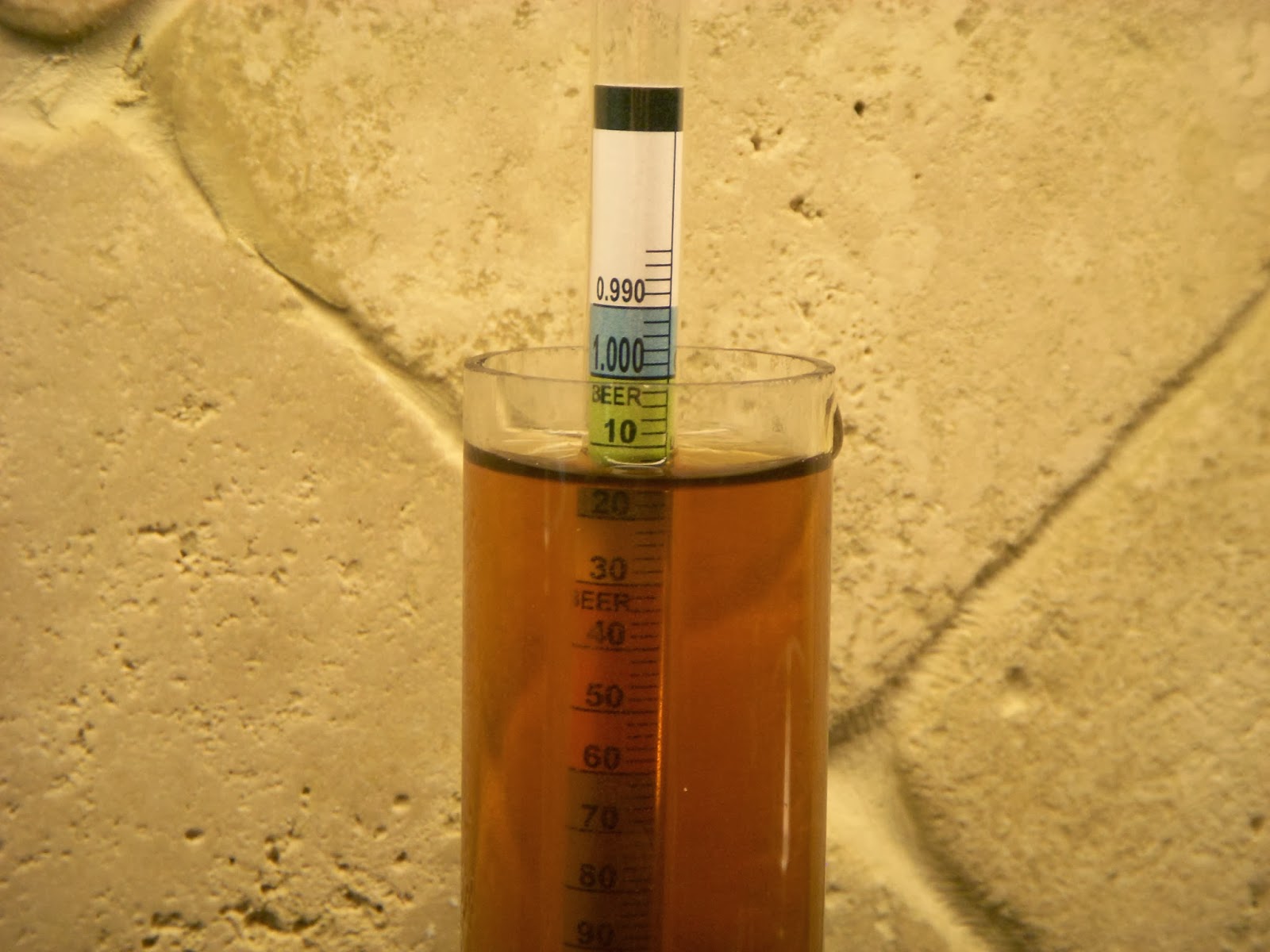
I was successful in getting the grains to convert into sugar (OG was low though), so that goal was accomplished and I gained some all grain confidence for my next batch. I think I was a bit aggressive on the bittering hops (I was just eyeing it because I don't have a scale yet) because it came out really bitter. For the next batch I think I will cut back on the bittering hops and throw them in as dry hops.

This was also my first attempt to cold crash to see if I could get some additional clarity in the finished product. I discovered that I need a two way air lock because my existing air lock kept trying to suck in the sanitizer as it cooled...

Update: I'm actually finishing up this post almost 9 months after actually brewing the batch... After now having completed a few all grain batches I noticed that the grain bill looked really light. I went back and took a look at the original recipe that I was using and it looks like I must have cut that grain in half when purchasing at the homebrew store knowing that I was going to be doing a 2.5 gallon batch, but I still purchased enough hops and yeast for a 5 gallon batch. Oops... So much for having my brewing recipe book right out on the counter. This goes a long way to explain why the OG was low and why it was so bitter!
 I started with 3 gallon of strike water at 160 f. The mash started almost exactly at 150 f and held its heat